


| # Model Overview | |
| A pre-trained model for simultaneous segmentation and classification of nuclei within multi-tissue histology images based on CoNSeP data. The details of the model can be found in [1]. | |
| The model is trained to simultaneously segment and classify nuclei, and a two-stage training approach is utilized: | |
| - Initialize the model with pre-trained weights, and train the decoder only for 50 epochs. | |
| - Finetune all layers for another 50 epochs. | |
| There are two training modes in total. If "original" mode is specified, [270, 270] and [80, 80] are used for `patch_size` and `out_size` respectively. If "fast" mode is specified, [256, 256] and [164, 164] are used for `patch_size` and `out_size` respectively. The results shown below are based on the "fast" mode. | |
| In this bundle, the first stage is trained with pre-trained weights from some internal data. The [original author's repo](https://github.com/vqdang/hover_net) and [torchvison](https://pytorch.org/vision/stable/_modules/torchvision/models/resnet.html#ResNet18_Weights) also provide pre-trained weights but for non-commercial use. | |
| Each user is responsible for checking the content of models/datasets and the applicable licenses and determining if suitable for the intended use. | |
| If you want to train the first stage with pre-trained weights, just specify `--network_def#pretrained_url <your pretrain weights URL>` in the training command below, such as [ImageNet](https://download.pytorch.org/models/resnet18-f37072fd.pth). | |
|  | |
| ## Data | |
| The training data is from <https://warwick.ac.uk/fac/cross_fac/tia/data/hovernet/>. | |
| - Target: segment instance-level nuclei and classify the nuclei type | |
| - Task: Segmentation and classification | |
| - Modality: RGB images | |
| - Size: 41 image tiles (2009 patches) | |
| The provided labelled data was partitioned, based on the original split, into training (27 tiles) and testing (14 tiles) datasets. | |
| You can download the dataset by using this command: | |
| ``` | |
| wget https://warwick.ac.uk/fac/cross_fac/tia/data/hovernet/consep_dataset.zip | |
| unzip consep_dataset.zip | |
| ``` | |
| ### Preprocessing | |
| After download the [datasets](https://warwick.ac.uk/fac/cross_fac/tia/data/hovernet/consep_dataset.zip), please run `scripts/prepare_patches.py` to prepare patches from tiles. Prepared patches are saved in `<your concep dataset path>`/Prepared. The implementation is referring to <https://github.com/vqdang/hover_net>. The command is like: | |
| ``` | |
| python scripts/prepare_patches.py --root <your concep dataset path> | |
| ``` | |
| ## Training configuration | |
| This model utilized a two-stage approach. The training was performed with the following: | |
| - GPU: At least 24GB of GPU memory. | |
| - Actual Model Input: 256 x 256 | |
| - AMP: True | |
| - Optimizer: Adam | |
| - Learning Rate: 1e-4 | |
| - Loss: HoVerNetLoss | |
| - Dataset Manager: CacheDataset | |
| ### Memory Consumption Warning | |
| If you face memory issues with CacheDataset, you can either switch to a regular Dataset class or lower the caching rate `cache_rate` in the configurations within range [0, 1] to minimize the System RAM requirements. | |
| ## Input | |
| Input: RGB images | |
| ## Output | |
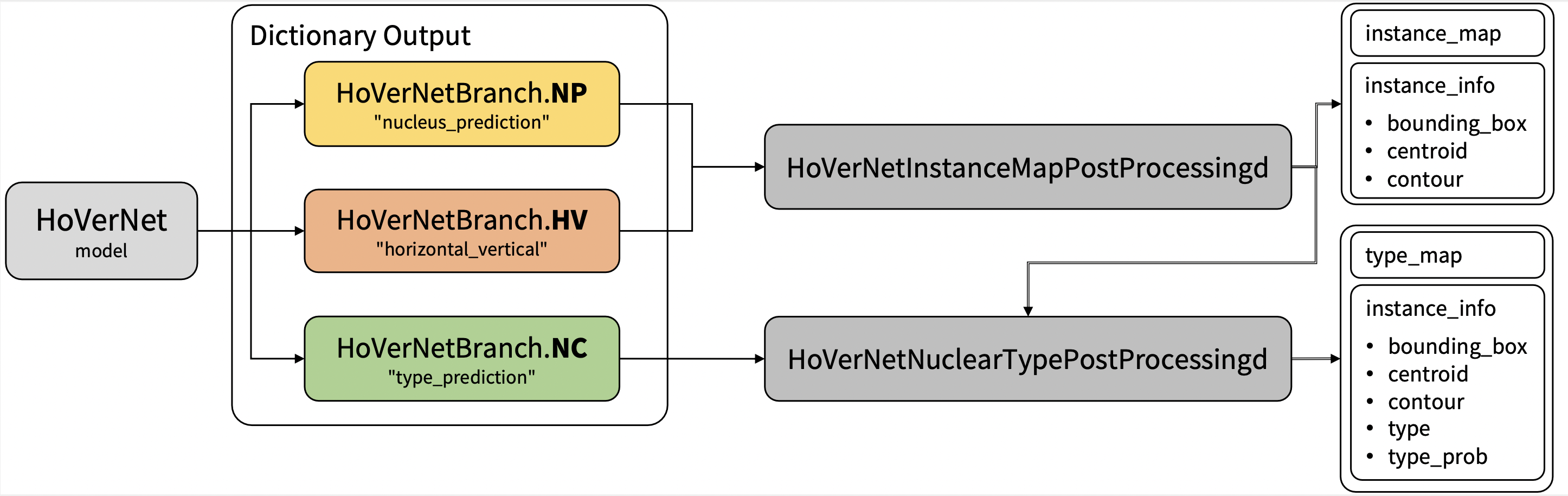
| Output: a dictionary with the following keys: | |
| 1. nucleus_prediction: predict whether or not a pixel belongs to the nuclei or background | |
| 2. horizontal_vertical: predict the horizontal and vertical distances of nuclear pixels to their centres of mass | |
| 3. type_prediction: predict the type of nucleus for each pixel | |
| ## Performance | |
| The achieved metrics on the validation data are: | |
| Fast mode: | |
| - Binary Dice: 0.8291 | |
| - PQ: 0.4973 | |
| - F1d: 0.7417 | |
| Note: | |
| - Binary Dice is calculated based on the whole input. PQ and F1d were calculated from https://github.com/vqdang/hover_net#inference. | |
| - This bundle is non-deterministic because of the bilinear interpolation used in the network. Therefore, reproducing the training process may not get exactly the same performance. | |
| Please refer to https://pytorch.org/docs/stable/notes/randomness.html#reproducibility for more details about reproducibility. | |
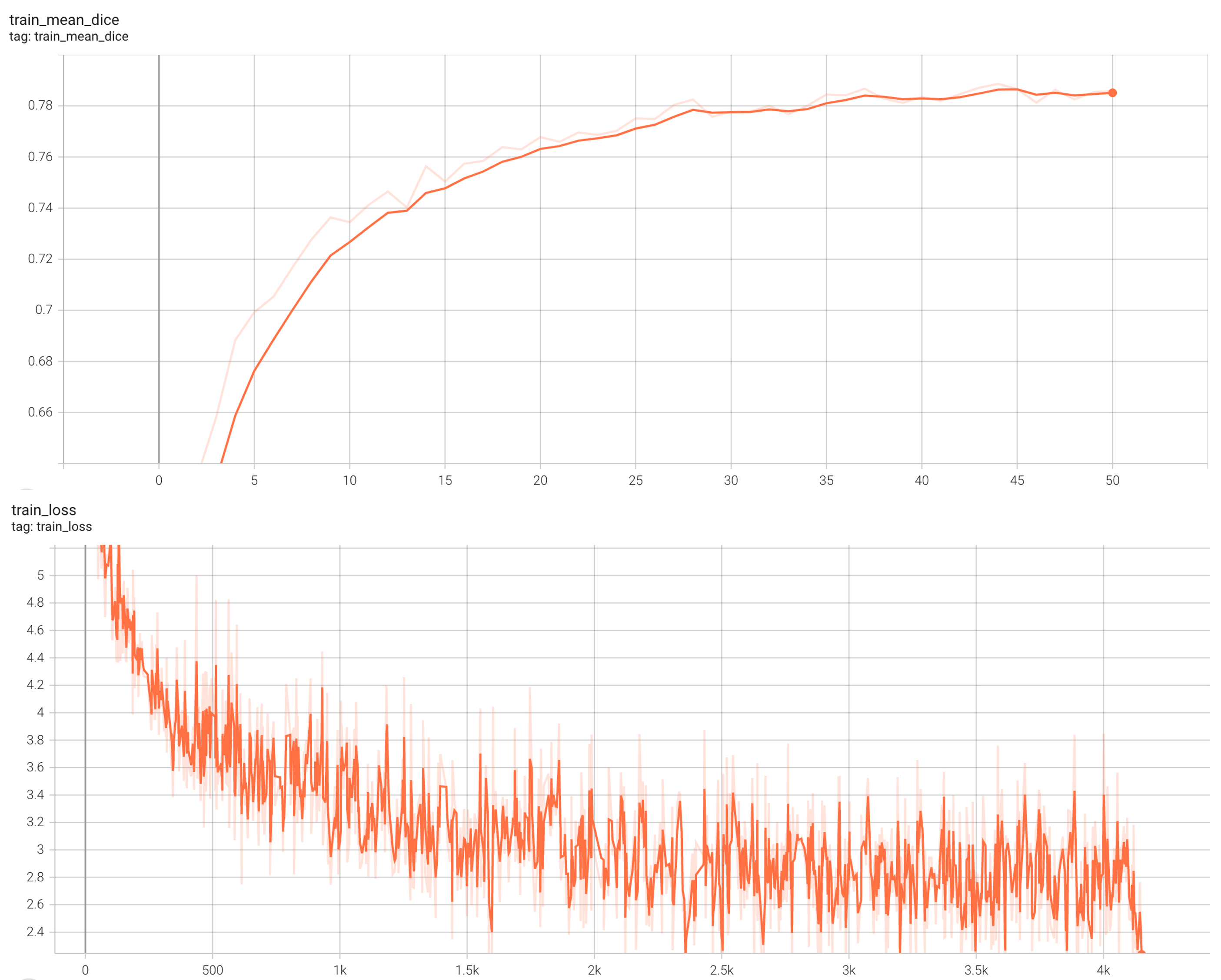
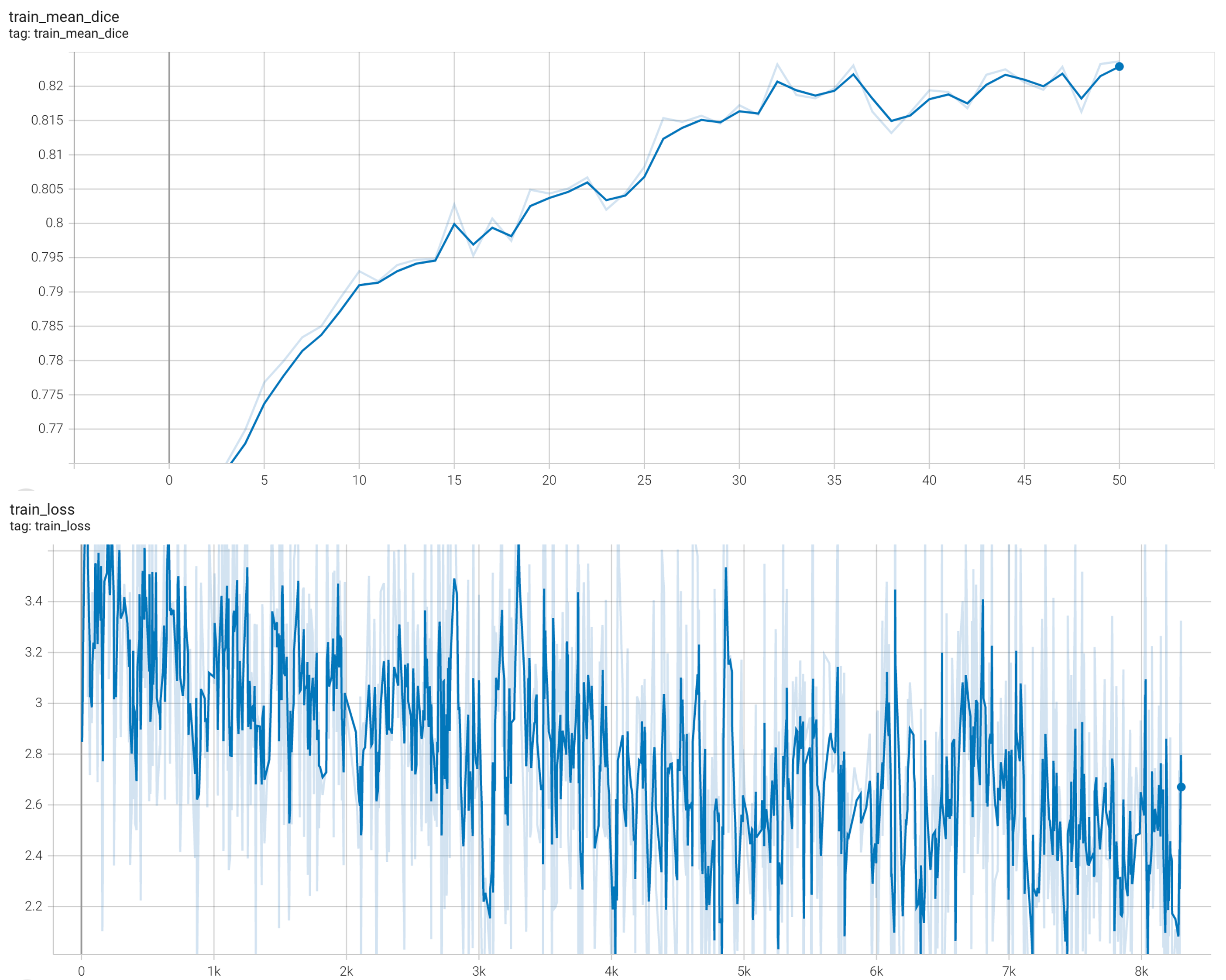
| #### Training Loss and Dice | |
| stage1: | |
|  | |
| stage2: | |
|  | |
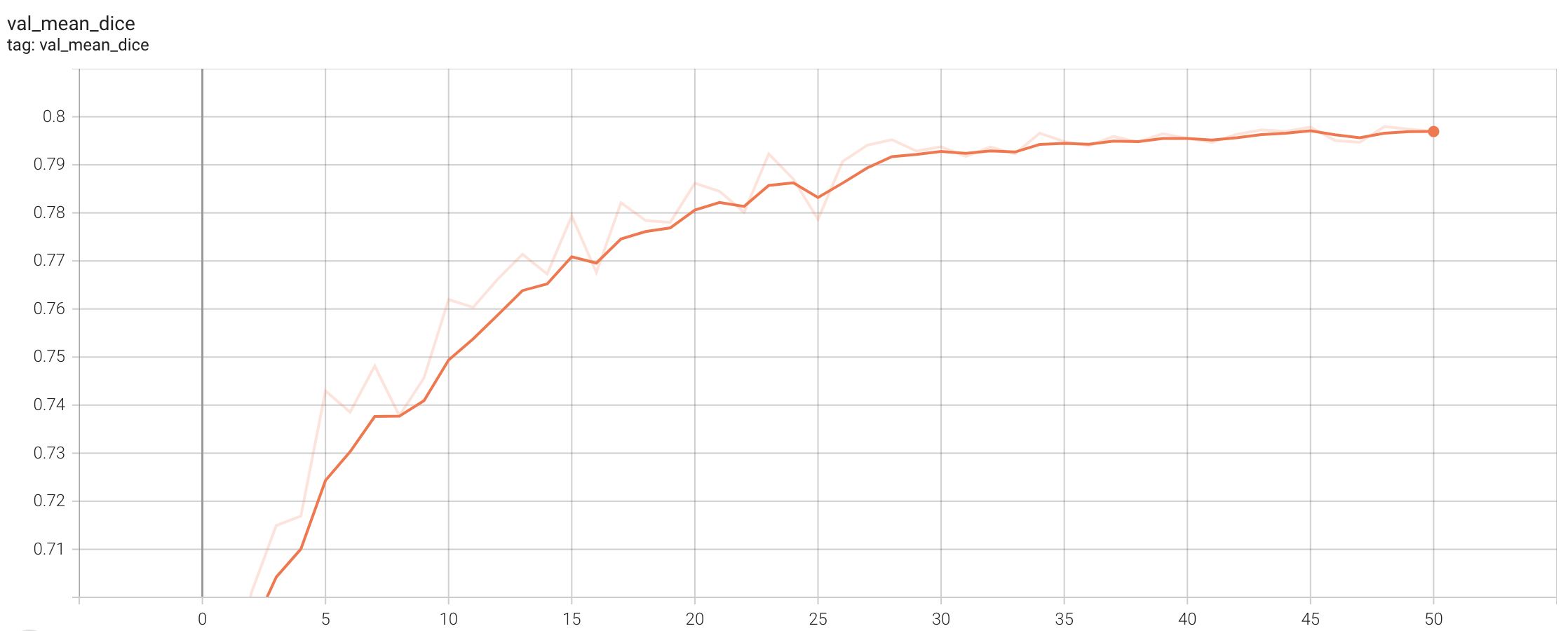
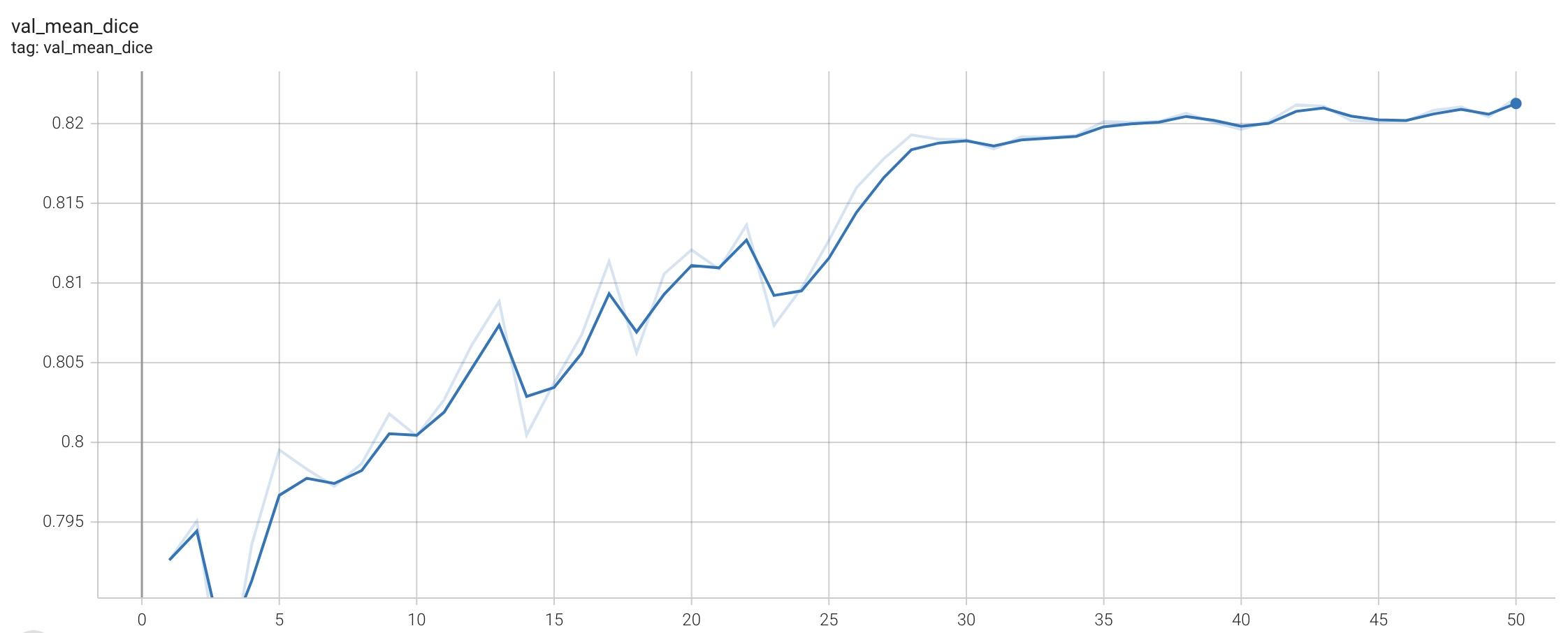
| #### Validation Dice | |
| stage1: | |
|  | |
| stage2: | |
|  | |
| #### TensorRT speedup | |
| This bundle supports acceleration with TensorRT. The table below displays the speedup ratios observed on an A100 80G GPU. Please note that 32-bit precision models are benchmarked with tf32 weight format. | |
| | method | torch_tf32(ms) | torch_amp(ms) | trt_tf32(ms) | trt_fp16(ms) | speedup amp | speedup tf32 | speedup fp16 | amp vs fp16| | |
| | :---: | :---: | :---: | :---: | :---: | :---: | :---: | :---: | :---: | | |
| | model computation | 24.55 | 20.14 | 10.85 | 5.63 | 1.22 | 2.26 | 4.36 | 3.58 | | |
| | end2end | 3451 | 3312 | 1318 | 878 | 1.04 | 2.62 | 3.93 | 3.77 | | |
| Where: | |
| - `model computation` means the speedup ratio of model's inference with a random input without preprocessing and postprocessing | |
| - `end2end` means run the bundle end-to-end with the TensorRT based model. | |
| - `torch_tf32` and `torch_amp` are for the PyTorch models with or without `amp` mode. | |
| - `trt_tf32` and `trt_fp16` are for the TensorRT based models converted in corresponding precision. | |
| - `speedup amp`, `speedup tf32` and `speedup fp16` are the speedup ratios of corresponding models versus the PyTorch float32 model | |
| - `amp vs fp16` is the speedup ratio between the PyTorch amp model and the TensorRT float16 based model. | |
| This result is benchmarked under: | |
| - TensorRT: 10.3.0+cuda12.6 | |
| - Torch-TensorRT Version: 2.4.0 | |
| - CPU Architecture: x86-64 | |
| - OS: ubuntu 20.04 | |
| - Python version:3.10.12 | |
| - CUDA version: 12.6 | |
| - GPU models and configuration: A100 80G | |
| ## MONAI Bundle Commands | |
| In addition to the Pythonic APIs, a few command line interfaces (CLI) are provided to interact with the bundle. The CLI supports flexible use cases, such as overriding configs at runtime and predefining arguments in a file. | |
| For more details usage instructions, visit the [MONAI Bundle Configuration Page](https://docs.monai.io/en/latest/config_syntax.html). | |
| #### Execute training, the evaluation during the training were evaluated on patches: | |
| Please note that if the default dataset path is not modified with the actual path in the bundle config files, you can also override it by using `--dataset_dir`: | |
| - Run first stage | |
| ``` | |
| python -m monai.bundle run --config_file configs/train.json --stage 0 --dataset_dir <actual dataset path> | |
| ``` | |
| - Run second stage | |
| ``` | |
| python -m monai.bundle run --config_file configs/train.json --network_def#freeze_encoder False --stage 1 --dataset_dir <actual dataset path> | |
| ``` | |
| #### Override the `train` config to execute multi-GPU training: | |
| - Run first stage | |
| ``` | |
| torchrun --standalone --nnodes=1 --nproc_per_node=2 -m monai.bundle run --config_file "['configs/train.json','configs/multi_gpu_train.json']" --batch_size 8 --network_def#freeze_encoder True --stage 0 | |
| ``` | |
| - Run second stage | |
| ``` | |
| torchrun --standalone --nnodes=1 --nproc_per_node=2 -m monai.bundle run --config_file "['configs/train.json','configs/multi_gpu_train.json']" --batch_size 4 --network_def#freeze_encoder False --stage 1 | |
| ``` | |
| #### Override the `train` config to execute evaluation with the trained model, here we evaluated dice from the whole input instead of the patches: | |
| ``` | |
| python -m monai.bundle run --config_file "['configs/train.json','configs/evaluate.json']" | |
| ``` | |
| #### Execute inference: | |
| ``` | |
| python -m monai.bundle run --config_file configs/inference.json | |
| ``` | |
| #### Execute inference with the TensorRT model: | |
| ``` | |
| python -m monai.bundle run --config_file "['configs/inference.json', 'configs/inference_trt.json']" | |
| ``` | |
| # References | |
| [1] Simon Graham, Quoc Dang Vu, Shan E Ahmed Raza, Ayesha Azam, Yee Wah Tsang, Jin Tae Kwak, Nasir Rajpoot, Hover-Net: Simultaneous segmentation and classification of nuclei in multi-tissue histology images, Medical Image Analysis, 2019 https://doi.org/10.1016/j.media.2019.101563 | |
| # License | |
| Copyright (c) MONAI Consortium | |
| Licensed under the Apache License, Version 2.0 (the "License"); | |
| you may not use this file except in compliance with the License. | |
| You may obtain a copy of the License at | |
| http://www.apache.org/licenses/LICENSE-2.0 | |
| Unless required by applicable law or agreed to in writing, software | |
| distributed under the License is distributed on an "AS IS" BASIS, | |
| WITHOUT WARRANTIES OR CONDITIONS OF ANY KIND, either express or implied. | |
| See the License for the specific language governing permissions and | |
| limitations under the License. | |